ChatGPT, Claude, Zapier, TaxDome...Technical Debt is Harming Your Firm
Tax Professionals and Financial Service Providers are spending more time testing new software than doing their own work; it could be creating a technical debt concern.
Unless you have been purposefully trying to avoid technology over the last several years, and especially months, you no doubt have seen the onslaught on new technologies that tax professionals, payroll providers, financial advisors, and more are working with. We see the, “Oh my gosh, I love TaxDome’s workflows,” and, “Holy crap! Have you seen what Claude can do?” The list goes on and on. However, we are only seeing a subset of the entire conversation.
On the backend, we are seeing the hidden message discussed in plain text. If you read the details hidden in the posts, you’ll see messaged like, “I hired a workflow specialist for $7,000,” or “Claude did it so fast for me, but I really don’t understand it.” The side conversations are where the true story comes out.
And, finally, now that we are years into a technological transformation within the industry, we are also seeing professionals shifting and changing the software they are using very quickly. A firm is using and has built out workflows using ChatGPT connected to Zapier; they then switch a few months later to Claude connected to Make and then a MongoDB. Meanwhile, they had invested hours/days/weeks building out their previous technology and processes, as well as invested hundreds or thousands of dollars. This is called technical debt.
What is Technical Debt?
Technical Debt is the phrase coined that describes the implied cost associated with building (or partially) building technology solutions in an expedited manner, usually leaving broken processes that introduce errors or require rework later.
Every time a firm tests new service or product, even while testing it, there is technical debt accrued. This could come in the form of time or cost. Most the time, while testing a new product, this is a few hours of effort and minimal cost; so we write it off. However, if hours and weeks are being spent on testing or building a new solution and it is only used for a short period of time, that effort in cost and hours is not recouped - technical debt is accrued.
The problem expands as this isn’t just a one-off issue. In fact, many firms are migrating from one tool to another within weeks. The amount of effort, time, and research is never quantified.
The debt continues to grow. Dave Ramsey would not be happy. ;-)
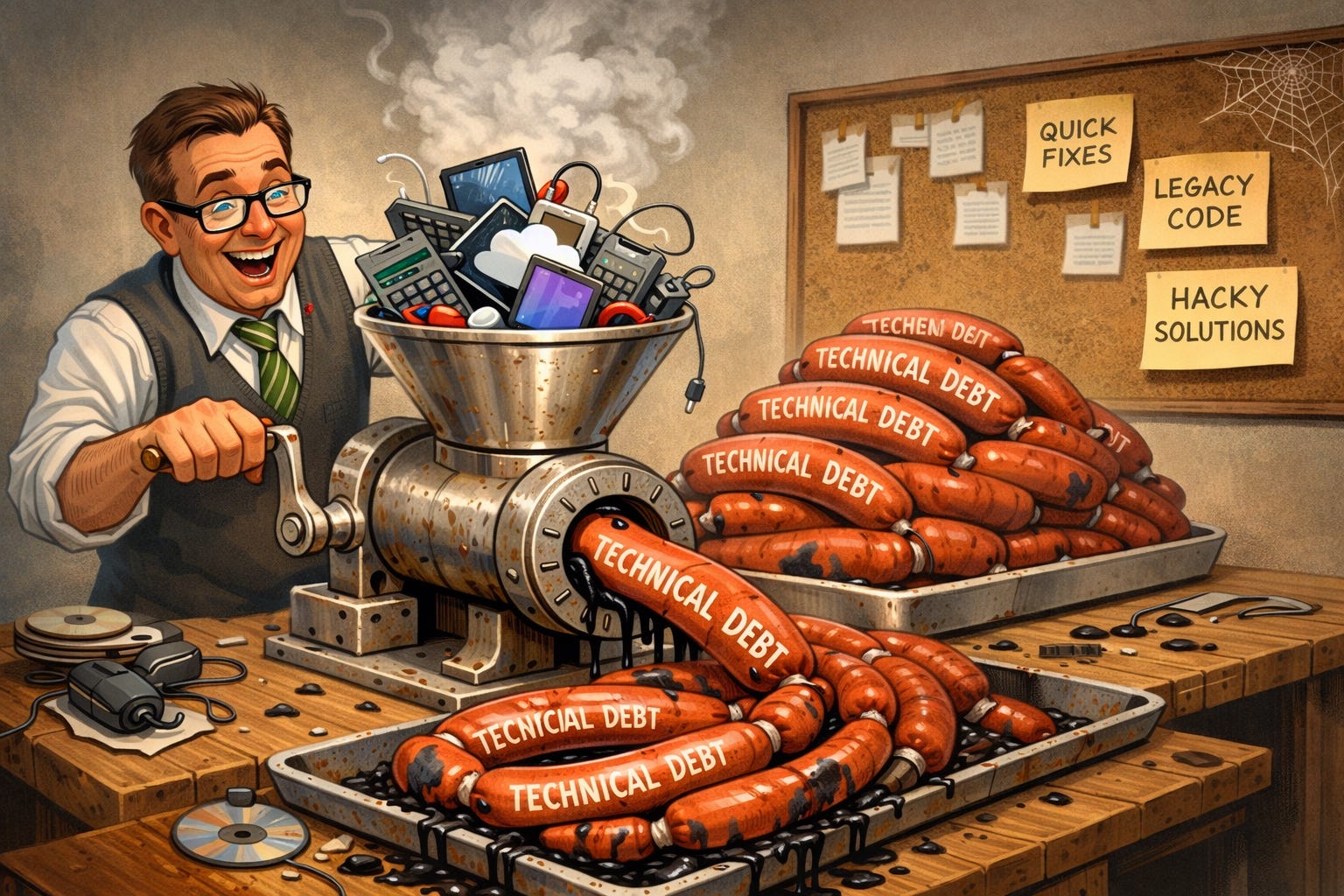
Nobody Wants to Know How the Sausage is Made
Outside of the Technical Debt issue, many firms are playing a dangerous game that quickly spreads beyond just the time and effort.
Inherent Knowledge. Most firms do not have in-house knowledge of how these technology platforms work, especially AI solutions. Moreso, many do not partner with external experts or resources, either. It is very dangerous to assume a solution works just because it appears to from a non-technical perspective.
Security. You didn’t think you’d escape me bringing this up, did you? Many of these platforms are being designed quickly and without proper vetting or testing. This leads to flaws within the solution that can easily be exploited. Additionally, loading confidential data into a platform opens a collection of security-related concerns. There may be disclosure requirements. They may not follow industry-required protocols. And, scarily more so, these platforms are targeted more than any other cloud-based platforms. In fact, as I write this, last week, 13 out of 16 breaches were rooted in or by AI platforms.
Solution Architecture. Especially when using vibe-coded solutions, firms typically do not understand how the solutions they built actually work. If the person building the solution cannot explain it, can they provide any guarantee as to the accuracy of the solution.
There is an old saying that once a person has seen sausage being made, they won’t want to eat sausage any more. The same goes for many of these technical platforms. If users saw what and how these solutions actually worked, would they really be ok using them?
Discharge of Debt
Alright, so you may be sitting here thinking, “Well, Brad, you just sound like you don’t want innovation or change or AI.” Nothing could be farther from the truth. I want exposure and understanding and improvement. I want to see this industry improve and be trusted advisors; when more time is spent focused on building solutions than actually delivery, there is a debt problem.
Now is the time. Create a priority list. What are your top concerns? What are you biggest areas of need and greatest opportunities for improvement? Focus there. Build an amazing solution, properly test it, protect it, and deploy it.
There is a reason software requires designers, programmers/engineers, database administrators, and security analysts. Make the right long-term investments and you will drastically minimize the amount of Technical Debt you acrrue.
Financial Guardians is a proud member of InCite, the recently launched online community exclusively for tax professionals, bookkeepers, and accountants. InCite members receive a 30% discount.
Financial Guardians has partnered with the California Society of Tax Consultants to provide a 30% access discount as well as many other offers. More info can be found at www.cstcsociety.org